

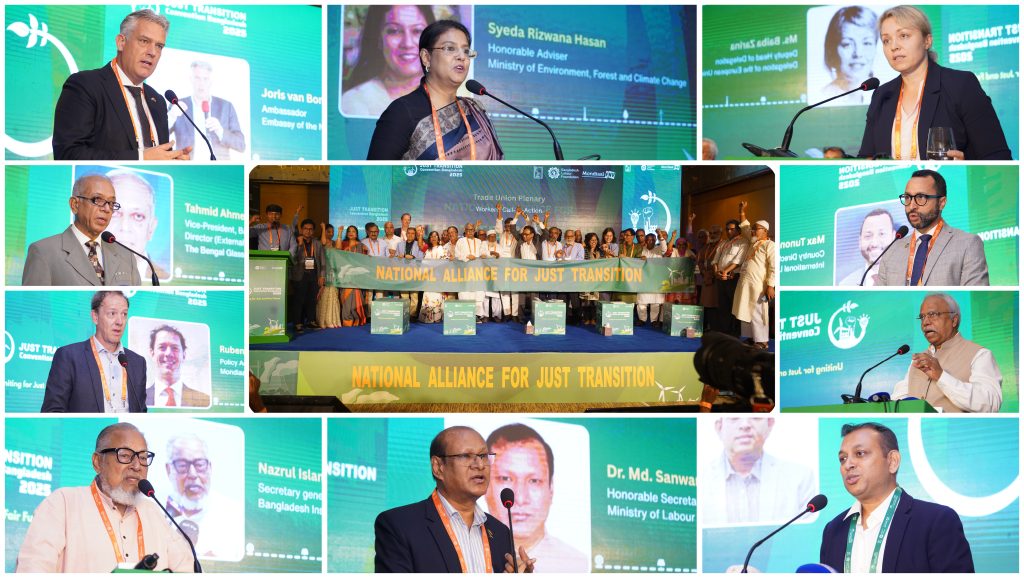
The Just Transition Convention Bangladesh 2025 was held on 24-25 September 2025 at The Westin, Dhaka, jointly organized by Bangladesh Labour Foundation (BLF), Bangladesh Institute of Labour Studies (BILS), , and national and international partners including the International Labour Organization (ILO), Mondiaal FNV, and the Embassy of the Kingdom of the Netherlands. The Convention served as a national platform for advancing dialogue on the integration of climate justice, labour rights, and technological transformation within Bangladesh’s sustainable development agenda.
The Convention brought together over 500 participants representing government agencies, employers’ organizations, trade unions, development partners, civil society, academia, and the media and over 65 panelists. Across ten sessions comprising an Opening Ceremony, a study dissemination event, six thematic parallel sessions, a trade union plenary, and a Closing Ceremony, the Convention examined the multifaceted dimensions of a Just Transition and its implications for Bangladesh’s economy, labour market, and policy landscape.
The Opening Ceremony underscored that a Just Transition must be inclusive, equitable, and grounded in social justice. Key speakers, including representatives from the Ministry of Labour and Employment, the ILO, and the Embassy of the Netherlands, emphasized that development must align economic growth with environmental sustainability and human rights. The ceremony highlighted the necessity of tripartite collaboration among the government, employers, and workers to ensure that the benefits of climate and technological transitions are shared fairly across society.
The session on Study Dissemination presented empirical findings from research conducted by the Bangladesh Labour Foundation on the impacts of climate change on Bangladesh’s labour force, particularly within the ready-made garment, leather, and footwear sectors. The study revealed that rising temperatures, heat stress, poor ventilation, and chemical exposure are significantly affecting worker health, productivity, and livelihoods. The findings called for a comprehensive national Just Transition roadmap anchored in social protection, skills development, and decent work.
The six thematic parallel sessions explored critical areas shaping the Just Transition discourse:
Climate Justice and Labour Equity emphasized policy coherence between climate and labour agendas, ensuring that environmental actions uphold workers’ rights and social equity.
Gender Justice in Climate and Technological Transitions addressed persistent inequalities in women’s access to work, leadership, and social protection, advocating for gender-responsive policy frameworks.
Digitalization, Automation, and Artificial Intelligence assessed the implications of technological transformation for employment, highlighting the need for reskilling, inclusion, and policy preparedness.
Climate Justice for Informal Workers focused on the vulnerabilities of the 85 percent of workers employed in the informal economy, stressing their recognition and protection within climate and labour policies.
Policy Shortfalls and Institutional Gaps identified weak coordination, fragmented mandates, and inadequate data systems as major constraints to implementing a Just Transition.
Youth and Women in Transition Leadership emphasized intergenerational inclusion, leadership development, and the integration of youth and women’s perspectives into national and global policymaking.
A key highlight of the Convention was the Trade Union Plenary: Workers’ Call to Action, during which the Dhaka Declaration 2025 on Climate and Technological Transition was formally announced. The Declaration outlined twelve strategic proposals, including the formulation of a National Just Transition Policy, establishment of a National Platform for Monitoring Just Transition, creation of a National Just Transition Fund, and integration of trade unions in the formulation and implementation of national policies. The Declaration reaffirmed that the transition towards a green and digital economy must prioritize workers’ rights, decent work, and social dialogue. Its core pillars were defined around policy coherence, financing mechanisms, inclusive participation, and governance accountability; establishing a holistic roadmap for advancing fair and equitable transitions in Bangladesh.
The Closing Ceremony concluded the Convention with the formal announcement of the National Alliance for Just Transition in Bangladesh (NAJTB), a collaborative platform designed to operationalize the outcomes of the Dhaka Declaration through coordinated policy advocacy, capacity development, and regional engagement.
Key Takeaways and Policy Outcomes:
The Convention reaffirmed that Just Transition is not only a climate or technological agenda but a social justice imperative. Key takeaways included: (1) the urgent need to institutionalize Just Transition principles in national policies; (2) commitment to develop a National Just Transition Policy and Fund; (3) recognition of trade unions, women, and youth as central actors in shaping equitable transition processes; and (4) consensus on enhancing tripartite cooperation and data-driven policy implementation. Collectively, these outcomes laid the foundation for embedding Just Transition within Bangladesh’s broader framework for sustainable and inclusive development.
In essence, the Just Transition Convention Bangladesh 2025 established a foundational framework for national action, uniting key stakeholders around a shared commitment to ensuring that Bangladesh’s pathway towards climate resilience and technological advancement remains just, inclusive, and worker-centered. The Convention marked a critical step in institutionalizing the Just Transition agenda within the country’s broader social, economic, and environmental policymaking processes.